
Search
 English
In recent years, with the rapid expansion of the new energy vehicle and energy storage industries, the term "lithium iron phosphate" has frequently appeared in our field of vision. Many people are curious about what exactly it is and why it is so popular in the battery field.
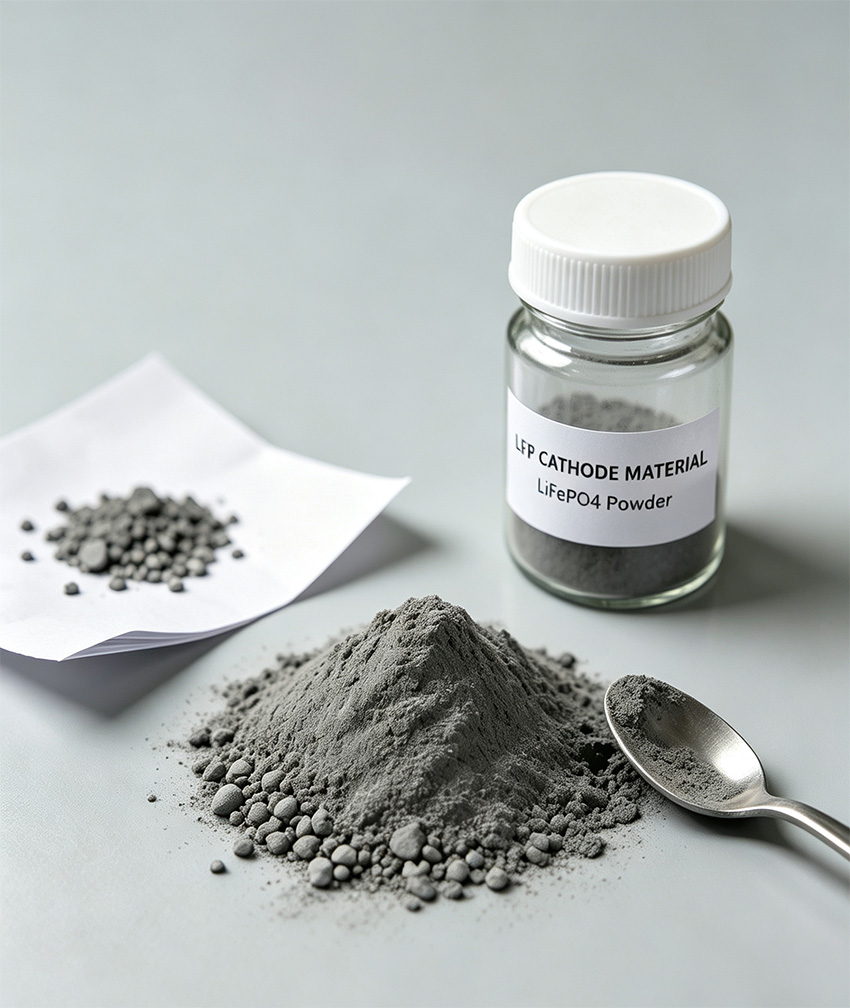
Lithium iron phosphate, with the chemical formula LiFePO₄ (abbreviated as LFP), is an inorganic compound. In the context of lithium batteries, it mainly refers to lithium iron phosphate used as the positive electrode material in lithium-ion batteries. We can think of a lithium battery as the "home" for lithium ions, with lithium iron phosphate responsible for building a stable structural framework for the positive electrode; its unique olivine crystal structure forms a stable channel for lithium ion movement.
During charging, lithium ions are released from the positive electrode, pass through the electrolyte and separator, and embed into the graphite of the negative electrode; during discharging, lithium ions migrate back to the positive electrode. The stable crystal structure makes the entire charging and discharging process less prone to structural damage.
Safety is the most crucial advantage of lithium iron phosphate batteries. Their crystal structure exhibits excellent thermal stability. Even under extreme conditions such as overcharging, high temperatures, or internal short circuits, the positive electrode structure is not easily collapsed, making it difficult to trigger oxygen evolution side reactions. This significantly reduces the probability of battery thermal runaway, fire, and explosion. In fields with stringent safety requirements, such as public transportation and large-scale energy storage power stations, safety is a crucial selection criterion.
Because the material structure deformation during charging and discharging is minimal, lithium iron phosphate batteries have an exceptionally long cycle life. Ordinary ternary lithium batteries have a cycle life of approximately 1000-2000 cycles, while lithium iron phosphate batteries can typically easily reach 3000 or even over 5000 cycles. This means that even after hundreds of thousands of kilometers of use in electric vehicles, the actual capacity degradation of the battery remains controllable; in energy storage, it can reduce the levelized cost of electricity (LCOE) over the entire battery's lifespan.
Lithium iron phosphate (LFP) batteries do not contain expensive precious metals such as cobalt and nickel, which are subject to high supply concentration and volatile prices. Their main raw materials are iron and phosphorus, both abundant and inexpensive elements found in the Earth's crust. This makes the production cost of LFP batteries consistently lower than that of ternary lithium batteries, and less affected by drastic fluctuations in raw material prices, thus facilitating the affordability of electric vehicles and energy storage devices.
The materials do not contain heavy metals or highly toxic substances, resulting in less environmental impact during production and disposal. The technology and processing costs for later recycling and reprocessing are also lower, better aligning with the industry requirements for the recycling of power batteries.
Every technology has two sides, and lithium iron phosphate is no exception: Relatively low energy density: Currently, the energy density of lithium iron phosphate batteries is generally lower than that of high-nickel ternary batteries, which means that vehicles equipped with batteries of the same weight may not have a superior driving range. However, with innovations in battery structure, system energy density has significantly improved, and many models can now achieve a pure electric range of 500-700 kilometers, more than sufficient for daily use.
Weak Low-Temperature Performance: In cold environments below -10°C, the lithium-ion migration rate of LFP batteries slows down, leading to a decrease in usable capacity and charging power. This requires technical means such as battery heating systems to mitigate, which is also the direction that engineers are continuously optimizing.
With its safety, long cycle life, and low cost, lithium iron phosphate (LFP) batteries are now widely used in multiple fields:
Electric commercial and passenger vehicles: Electric buses, logistics vehicles, and many cost-effective household electric vehicles commonly use LFP batteries.
Energy storage systems: From residential wall-mounted energy storage and industrial peak shaving and valley filling to grid-scale large-scale energy storage power stations, LFP is the dominant technology.
Two-wheeled vehicles and starting power supplies: Lithium batteries for electric bicycles and motorcycles, as well as some 12V auxiliary batteries in automobiles, are also starting to use LFP batteries, which are both lightweight and safe.
Base station backup power and data centers: As an uninterruptible power supply, it ensures the stability of communication and computing systems.
Lithium iron phosphate (LFP) is not an "obsolete material," but rather a pragmatic choice made by the market. It is not intended to completely replace other battery technologies, but rather to find an excellent balance between safety, cost, and lifespan. In the past two years, LFP has significantly surpassed other technologies in global power and energy storage battery shipments, fully demonstrating that it meets the most fundamental needs of the era of large-scale electrification—affordability and peace of mind.
(+86)400-990-6600
sales.lib@mikrouna.com